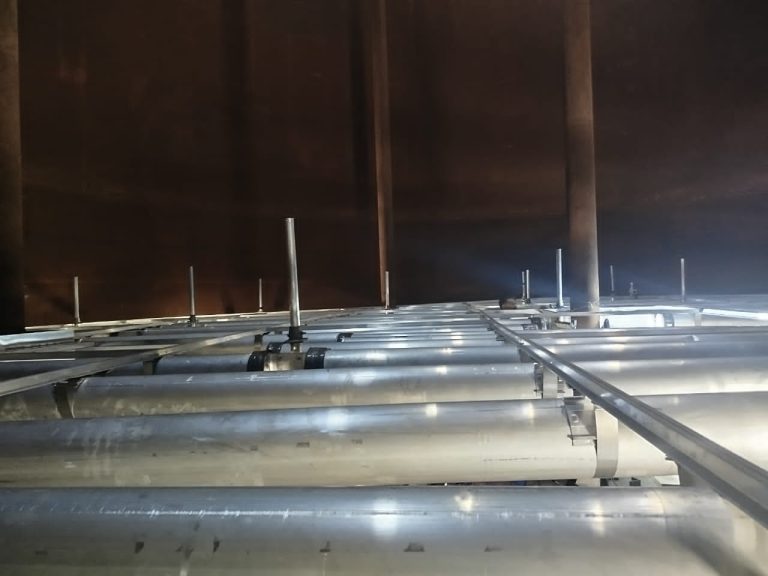
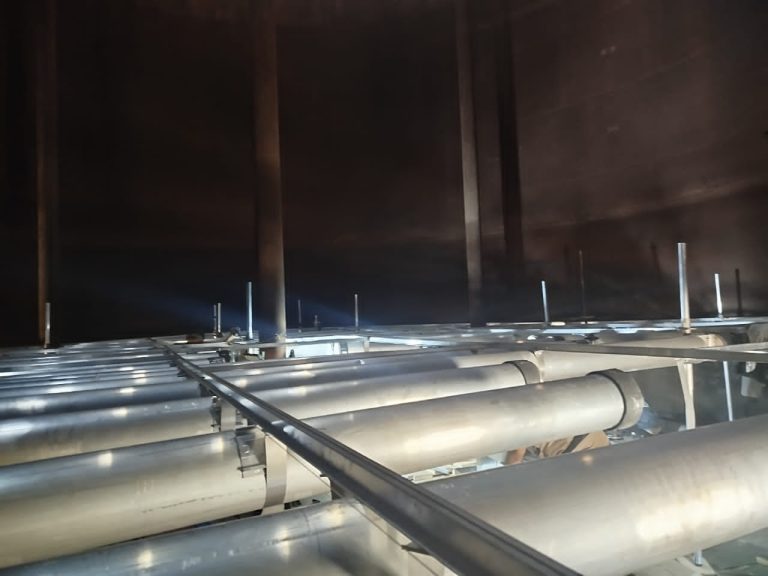
Internal Floating Roofs are installed in Fixed Roof Tanks to control the vapor emissions from volatile hydrocarbon liquids. Atmospheric storage tanks have contributed significantly to emissions of volatile organic hydrocarbons (VOC’s). When our society developed an understanding of the economic and environmental impact as a result hereof several products were developed to reduce emissions. At the basis and forefront of these developments was the internal floating roof. By covering major part of the liquid surface and through an effective seal the emission reduction after installing an internal floating roof is in excess of 90%. The API committee has also acknowledged the importance and relevance of this development by maintaining a standard for internal floating roofs (API 650 Appendix H). Floating roofs are available in a wide range of materials including Aluminum and stainless steel, executed as vapor containing as well as direct contact roofs.
Aluminum internal floating roofs offer several operational, economic, and environmental benefits:
Reduces Vapor Loss: Significantly cuts down volatile organic compound (VOC) emissions by creating a physical barrier between stored liquid and vapor space.
Corrosion Resistance: Aluminum is naturally resistant to corrosion, especially from petroleum products and many chemicals.
Lightweight: Easier and faster to install than steel IFRs, putting less stress on tank structures.
Cost-Effective: Lower life-cycle costs due to minimal maintenance, longer lifespan, and regulatory compliance.
Improved Safety: Reduces explosive vapor accumulation in the vapor space.
Regulatory Compliance: Helps meet air quality regulations (e.g., EPA 40 CFR Part 60, Part 63).
Aluminum IFRs are widely used across industries that store volatile liquids:
Petroleum Terminals
Refineries
Chemical Storage Facilities
Tank Farms
Biofuels and Ethanol Storage
Aviation Fuel Storage
Crude Oil Storage
They are generally installed in above-ground, fixed-roof storage tanks to control vapor emissions and meet environmental regulations.
| Feature | Details |
|---|---|
| Material | Aluminum alloys (e.g., 6061) or Stainless Steel |
| Diameter Range | Typically from 10 m to +100 m |
| Design Standard | API 650 Appendix H, API 620, or custom to project needs |
| Deck Types | Pontoon type, full contact type, hybrid |
| Seal Systems | Primary and optional secondary seals (wiper, shoe, vapor-mounted) |
| Buoyancy | Provided by extruded pontoons or foam-filled compartments |
| Corrosion Resistance | High, with anodized or bare aluminum |
| Fire Safety | Optional anti-static and flame-arresting components |
| Inspection Ports | Included for routine monitoring |
Tank Preparation – Ensure the fixed-roof tank is clean and accessible.
Component Delivery & Assembly – IFR parts are typically shipped unassembled; on-site assembly is common.
Insertion into Tank – Assembled components are introduced through the tank’s roof manway or access port.
Floatation Testing – Verify buoyancy and seal functionality.
Final Checks – Ensure IFR sits level and seals properly with the tank wall.
Routine Inspection (annually or per regulation):
Check seals for wear, tear, or misalignment.
Inspect pontoons for leaks or damage.
Ensure hardware integrity (bolts, connectors).
Seal Replacement: Typically every 5–10 years depending on usage.
Cleaning: Occasional cleaning during tank shut-downs.
Minimal Downtime: Maintenance is infrequent and does not usually require tank drainage if done during regular inspection cycles.
Emission Reduction: Up to 98% reduction in VOC emissions compared to fixed-roof tanks without IFRs.
Product Conservation: Minimizes evaporation losses, reducing the need for frequent product replenishment.
Energy Efficiency: Reduces the need for vapor control systems like flares or thermal oxidizers.
Regulatory Compliance: Supports sustainability goals and air pollution control laws.
Recyclable Material: Aluminum is highly recyclable, reducing lifecycle environmental impact.
Long Service Life: Reduces material consumption over time.
Low Maintenance = Lower Footprint: Fewer resources used for upkeep.
End-of-Life Disposal: While recyclable, improper disposal could lead to landfill waste.
Manufacturing Footprint: Aluminum production is energy-intensive (though often offset by recycling benefits).